How to Reply to Her Instagram Story (2026 Guide)

Story replies are the cheat code that nobody treats like a cheat code. Every other way to start a conversation on Instagram has friction. Cold DMs land in message requests where she checks once a week between deleting spam. Comments are public and performative. Follow-for-follow is not a conversation. But a story reply? It lands in her primary inbox, it has built-in context because you are responding to something she chose to share, and it feels natural because that is literally what the feature was designed for.
Here's the psychology people miss. When a girl posts a story, she is inviting attention. She wants people to see it, react to it, engage with it. Primarily from friends, sure. But the door is open. You're not barging in. You're walking through a door she left open on purpose. That reframe matters because it changes how you write the reply. You're not cold-approaching a stranger. You're responding to an invitation.
A good Instagram story reply is a one-to-two sentence response that references something specific in her story, adds your take, and gives her an easy reason to reply back.
And yet most guys still send a fire emoji and call it a day. Or they overthink it for twenty minutes, draft something in their notes app, delete it, and send nothing. Both are the wrong move. This post is the full breakdown. Which stories to reply to, which to skip, what to say for every type of story she posts, and the difference between a reply that starts a real conversation and one that dies on delivery.
One thing to get comfortable with upfront: this is a volume game. The majority of your story replies to women who don't know you will go unanswered. That's not failure. That's the math. If you're not okay with that, go outside and talk to girls in person where the success rate is higher. But online, you have to accept the ratios and keep going. The guys who get results are the ones who send ten thoughtful replies a week and start three conversations, not the ones who agonize over one perfect message.
In This Post
- Why Story Replies Beat Every Other DM Method
- Which Stories to Reply To (And Which to Skip)
- What to Say for Every Type of Story
- The Anatomy of a Reply That Gets a Response
- The Replies That Die on Arrival
- Timing and Frequency
- FAQ
Why Story Replies Beat Every Other DM Method
The structural advantage is simple and it is massive. When you reply to someone's Instagram story, your message goes directly to their primary inbox. Not message requests. Not the filtered folder. Primary. Instagram routes story replies as direct conversations, which means your reply sits right next to messages from her best friend and her mom. That placement alone is worth more than any clever opener you could write in a cold DM.
600 million people use Instagram Stories daily as of early 2026. She is posting stories. She is watching stories. She is living inside that format. And one in five Instagram Stories generates at least one direct message from viewers. The feature is built for conversation. You are just not using it right.
Here is why story replies outperform every alternative.
Cold DMs from non-followers go to message requests. She has to actively open a separate folder to see your message. Most people check this folder rarely if ever. Your perfectly crafted opener is sitting in a graveyard next to crypto pitches and MLM invites.
Story replies come with the story attached. When she opens your reply, the story is right there as context. She does not have to wonder what you are talking about or why a stranger is in her inbox. The story is the reason. The story is the context. The story is the conversation starter that she created for you.
Story replies feel like reactions, not approaches. A cold DM says "I found your profile and I am making a move." A story reply says "I saw what you posted and I had a thought." One puts pressure on her. The other gives her space. The framing difference changes everything about how she reads your message.
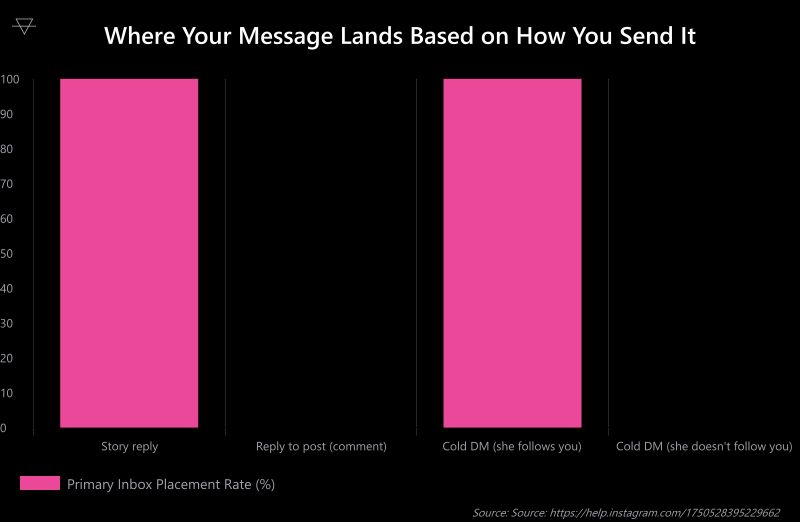
This is not a marginal advantage. This is a structural one. If you have been struggling with how to DM girls on Instagram, story replies are the answer you keep walking past.
Which Stories to Reply To
Not every story is an opportunity. Some are invitations to engage. Others are just noise she posted without thinking. Learning to tell the difference saves you from sending replies that have nowhere to go.
Stories Worth Replying To
Travel and location stories. She is somewhere interesting. She posted it because she wants people to know. Ask about the place. Share your experience if you have been there. "That coastline looks unreal, where is that?" gives her an easy answer and opens a thread about travel.
Food and restaurant stories. Universally safe territory. Everyone has food opinions. "Ok that looks dangerous. What did you order?" works because food is low-stakes and high-interest. Nobody has ever been creeped out by a question about pasta.
Music shares. She posted a song or a concert story. This is a direct signal about her personality. If you know the artist, say something specific. "Their live shows are a different experience. Did they play [specific song]?" shows genuine knowledge, not just a surface reaction.
Hot takes and opinion stories. She posted a poll, a question box, or a text rant about something she cares about. These are literally designed to generate responses. Agree with a twist. Disagree respectfully. Add a layer she did not consider. She wants engagement on these. Give it to her.
Pet content. She posted her dog or cat. This is the easiest reply in the world. People love talking about their pets more than they love talking about themselves. "What breed is that? My neighbor has one and it has the exact same energy." Done. Conversation started.
Activity and hobby stories. She posted herself hiking, cooking, playing a sport, reading, painting. Reference the activity with specificity. Relate to it if you can. If she posted a bike ride through the country, don't just say "nice ride." Say "I did one of those last month and almost fell off at a cattle grid. Please tell me you're better at this than me." You're showing you actually do the thing, you're being self-deprecating, and you're inviting her to one-up you. That's three conversation hooks in two sentences.
Stories to Skip
Selfies with no context. Just a photo of her face. No location tag, no caption, no story to react to. Replying to a bare selfie almost always reads as commenting on her appearance, which is the one thing you should not lead with. Wait for a story with actual content.
Reposts of viral content. She shared a meme or a reel someone else made. There is no personal connection here. You would be commenting on someone else's content that she happened to share. Unless the repost reveals something specific about her taste, skip it.
Story dumps of 15+ frames. She posted her entire day in 15 slides. Replying to slide 12 tells her you watched all 15, which might come across as more attention than she is comfortable with from someone she does not know well yet.
Vague emotional stories. Black screen with song lyrics. Cryptic text about "people who don't deserve your energy." These are venting, not inviting conversation. Engaging here positions you as the guy who swoops in when she is vulnerable. That is not a good look.
What to Say for Every Type of Story
This is where the existing guides fall short. They give you one or two generic templates and call it a day. But a travel story and a gym story need completely different replies. The context changes everything. Here is what to say for every common story type, with the reasoning behind each one.
Travel Stories
She posted a photo from a trip. A beach, a city, a mountain, a random street in a country you have never been to.
Good replies:
- "I have been trying to plan a trip there for months. Is it as good as the photos or are you just a good photographer"
- "That market in the background looks like it has better food than the restaurant. Did you go in"
- "Ok I need the actual itinerary because my version of travel planning is opening Google Maps and panicking"
Why these work: They ask questions only she can answer based on her actual experience. They show genuine interest in the place, not her appearance in front of the place. They give her multiple threads to respond to.
What not to say: "Wow looks amazing!" This says nothing. It adds nothing. It goes nowhere.
Food and Restaurant Stories
She posted a plate of food, a restaurant interior, a cooking attempt, or a coffee order.
Good replies:
- "That looks like it changed your life. What is it and do they deliver to [your city]"
- "Wait is that the place with no sign on the door? I walked past it three times before I found it"
- "Your latte art is better than anything my local place has ever managed and they have been open for six years"
Why these work: Food is the most universally comfortable conversation topic. Sharing a restaurant recommendation or a cooking opinion is low-stakes but high-engagement. These replies show you are paying attention to the content, not just reacting to the person.
Music and Concert Stories
She shared a song, posted from a show, or put up a screenshot of her listening stats.
Good replies:
- "Their second album is criminally underrated. Are you a deep cuts person or do you stick to the hits"
- "I saw them live last year and the sound was insane. Did they open with [specific song]"
- "Your music taste just earned a lot of respect. What else is in rotation right now"
Why these work: Music taste is identity. Engaging with it tells her you see her personality, not just her face. Being specific about the artist proves you actually know them. The question invites her to share more about herself in a way that feels natural.
Gym and Fitness Stories
She posted a workout, a PR, a run screenshot, or a gym selfie with actual training context.
Good replies:
- "That deadlift lockout was clean. Most people cheat the last inch. How long did it take you to hit that weight"
- "Running in that heat is a different kind of commitment. What was the route"
- "I have been stuck at the same squat numbers for weeks. What program are you running because mine is clearly broken"
Why these work: They engage with the fitness content specifically. Commenting on technique or asking about programming shows you actually train. It turns the reply into a shared-interest conversation instead of a "wow you are so strong" compliment that she has heard a hundred times.
What not to say: Anything about her body. "You look great" on a gym story is the fastest way to get ignored. She posted the workout, not a modeling photo.
Pet Stories
She posted her dog, cat, or any animal with a pulse.
Good replies:
- "That face is the face of a dog who just did something wrong and knows you can't stay mad. What did they do"
- "I need this dog's name immediately. This is urgent information"
- "My dog would have the exact same energy if I put him in that situation. Does yours also refuse to [specific thing]"
Why these work: People will talk about their pets for hours if you let them. Asking the pet's name or guessing their personality gives her an easy and enjoyable response. Pet content is also emotionally safe territory. You are bonding over her animal, not making a move.
Selfie or Outfit Stories (With Context)
She posted a selfie with a caption, a location tag, or context that gives you something to work with beyond her appearance.
Good replies:
- "Is that [specific restaurant/bar] in the background? Their [specific menu item] is either incredible or a war crime depending on who you ask"
- "That jacket is going to start arguments. Where is it from because I know someone who needs it"
- "The caption is doing a lot of heavy lifting here. What is the full story"
Why these work: They engage with the context around the selfie, not the selfie itself. The location, the outfit as a fashion choice, the caption. This avoids the appearance-compliment trap while still showing you paid attention.
Meme and Opinion Stories
She posted a meme she relates to, a hot take, a poll, or a text-based story sharing her opinion on something.
Good replies:
- "This is a correct opinion and I will fight anyone who disagrees. But I need to know your reasoning"
- "I was on your side until the last sentence. Now I have questions"
- "The fact that you posted this tells me we have the exact same internet. That is either great or concerning"
Why these work: She posted an opinion because she wants engagement. Agreeing with a twist or disagreeing with humor creates the back-and-forth that turns a reply into a conversation. These are the highest-conversion story types because she is already in a conversational mindset.
The Anatomy of a Reply That Gets a Response
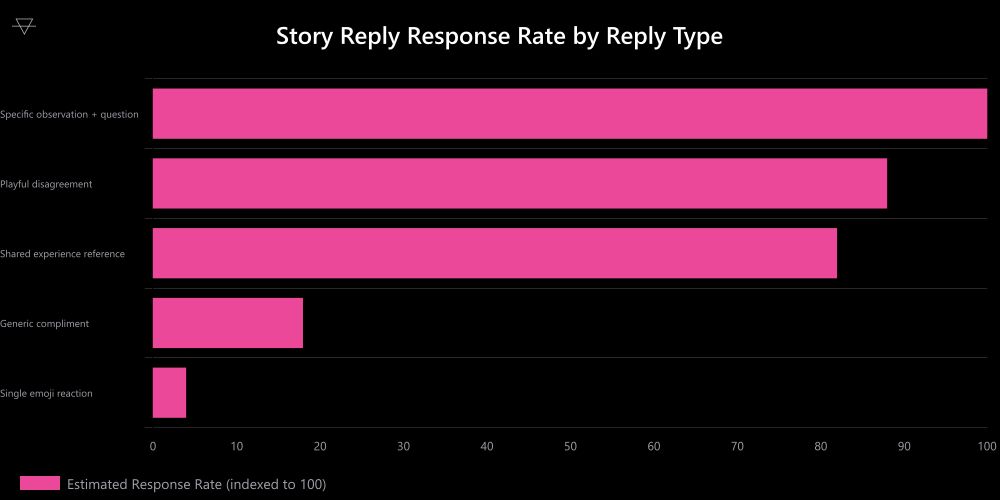
Every story reply that actually starts a conversation shares three components. Miss any one of them and the reply either gets ignored or gets a polite dead-end response that is arguably worse than being ignored.
There's a thing I call pity jail. It's when she replies out of pure politeness. A one-word answer. A "haha thanks." She doesn't want to talk to you but she feels bad ignoring you. Once you're in pity jail, there's no getting out. She's already categorized you as a chore, and nobody continues a chore voluntarily. The three components below are specifically designed to keep you out of pity jail by making the reply feel like something she actually wants to respond to.
1. Proof You Watched
The reply has to reference something specific from the story. Not the topic. The detail. Not "cool trip" but "that market in the background." Not "nice food" but "is that the place with the blue tiles and no menu." The detail is what separates your reply from the thirty fire emojis she already received.
2. Your Take (With Tension)
Add something from your own perspective. An opinion, an experience, a reaction that shows personality. "That trail looks like it tried to kill you" is a take. "Nice hike" is not. Your take is what makes the reply a two-way interaction instead of a one-way compliment.
The best takes have a little tension baked in. Not conflict. Tension. Mystery. Curiosity. Something that makes her think "wait, is this a compliment or is he messing with me?" That ambiguity is what makes a reply interesting enough to respond to. I once replied to a coaching influencer's story telling her she looked like a specific male influencer and asked if he was her father. She replied within two minutes. Was it a compliment? An insult? She had to find out. That's the energy you want.
The mindset that produces this kind of reply is simple: you're having fun. You're not writing for a specific response. You're not rigid. You're not thinking about what happens next. You're just enjoying a moment of communication with another human being. I know that sounds like voodoo spiritual nonsense, but when you're in that headspace, what you come up with is genuinely better than anything you'd write while overthinking.
3. A Low-Pressure Exit
Give her an easy way to respond that does not feel like a commitment. A casual question works. "Where is that?" or "what did you order?" or "how long was the hike?" The question should be specific enough to show interest but simple enough that she can answer in one sentence without thinking too hard.
When all three hit, the reply feels like a conversation that already started. She is not deciding whether to talk to a stranger. She is deciding whether to finish a conversation that is already happening. That reframe is everything.
Piercr reads her Instagram profile and stories so your reply references real details from her life. No generic templates. No guessing. Try it free.
The Replies That Die on Arrival
Some story replies are dead before she even reads them. Here's a good rule: whatever you're thinking of sending right now is probably exactly what you should not send. That instinct, the first thing that comes to mind, is the same instinct every other guy follows. That's why it doesn't work.
The solo emoji. Fire emoji. Heart-eyes. Laughing face. These are not replies. They are reactions. Instagram literally has a separate reaction feature for this. When you send a single emoji as a reply, you are telling her that her story was worth a thumb tap but not a sentence. That is not a conversation starter. That is a notification she swipes away.
The appearance compliment. "You look amazing." "Stunning." "Wow." She knows. The forty guys before you said the same thing. An appearance compliment on a story reply is the conversation equivalent of a dead end. Where does she go from "you look amazing"? She says "thanks" and the conversation is over before it began. We covered this in depth in the Instagram DM openers guide. Specificity about content beats compliments about appearance every single time.
Now, if you absolutely must compliment, make it so specific it's interesting or so over the top it becomes funny. "Your hair is nice" is dead. "Your eyes are as beautiful as the star-filled night sky over a Mediterranean village" is so absurdly cheesy that it loops back around to charming because she knows you're being ridiculous on purpose. The line between cringe and comedy is delivery and self-awareness. But honestly, you're better off skipping the compliment entirely and engaging with the content.
The one-word validation. "Vibes." "Goals." "Mood." These words communicate nothing. They reference nothing specific. They could be sent to any story by any person. She is not going to build a conversation on "vibes."
The interview question. "Where was that taken?" with zero context or personality is technically a question, but it reads like a form. Compare "Where was that taken?" to "That cliff looks like it has a personal grudge against tourists. Where is it and should I be scared." Same question. Completely different energy.
The paragraph reply. Four sentences on a story reply is too much. You are responding to a 15-second piece of content. Match the energy. One to two sentences. If you need more words, save them for the conversation that follows.
Timing and Frequency
When you reply matters almost as much as what you say. Reply too fast and you look like you are sitting there watching her stories in real time. Reply too late and the story has expired and the context is gone.
The sweet spot is 15 minutes to 2 hours after she posts. This window says you saw her story during a normal scroll, had a thought, and said it. Natural. Unforced. Not obsessive.
Do not reply at 3 AM. Even if you are genuinely awake and saw her story. A 3 AM story reply communicates something different from a 7 PM story reply, regardless of what you actually typed. Time-of-day context matters.
One reply per week is better than five. If you are replying to every story she posts, you are not starting conversations. You are running surveillance. Pick the stories that genuinely connect to your interests or give you something real to say. The restraint makes each reply feel more intentional.
Do not reply to consecutive stories on the same day. She posted three stories today. You replied to one. That is the right number. Replying to all three tells her you watched everything and had thoughts about each one, which is more attention than most people are comfortable receiving from someone they do not know well.
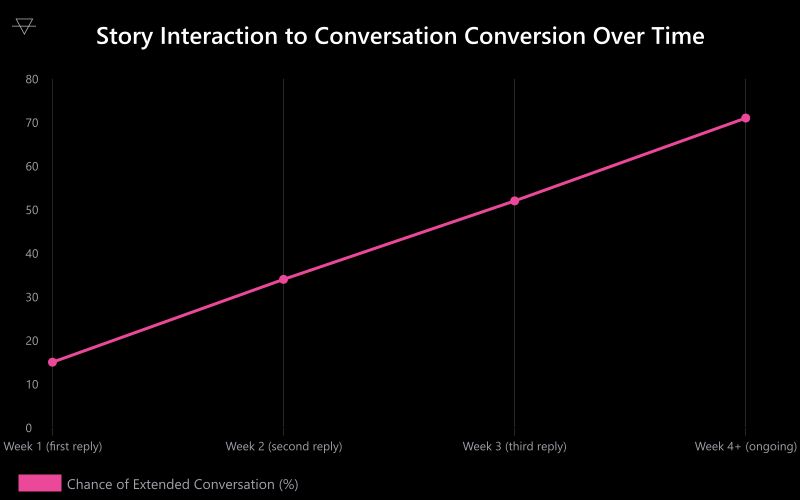
The data shows something important: consistency over time beats intensity in a single moment. Accounts that reply to 50% or more of interactions within the first hour see 23% higher engagement on future posts. The same principle applies to dating. She notices patterns. One thoughtful reply every week for a month builds more familiarity than four replies in one night followed by silence.
This is the same long-game principle from our guide on Instagram story ideas that attract women. The story-to-DM pipeline is not a single interaction. It is a series of small moments that add up to recognition, then familiarity, then interest.
The Story-to-Conversation Pipeline
Here is what the progression looks like in practice.
Week 1: Reply to one story with a specific observation and a question. She replies. You respond once more to keep it going, then let the conversation close naturally. You are now in her primary inbox and she has seen your profile.
Week 2: Reply to a different type of story. Show range. If you replied to a food story last week, reply to a travel or music story this week. She starts recognizing your name and associating it with good conversation.
Week 3: The replies start getting longer on both sides. She is giving you more than one-sentence answers. She might start replying to your stories too. This is the reciprocity signal that means the dynamic is shifting from stranger-to-stranger to something warmer.
Week 4 and beyond: The conversation transitions from story-based to direct. You stop needing a story as an excuse to message her. The warmup already happened. If you want to know how to navigate this transition, our guide on how to start a conversation on Instagram covers the first five messages in detail.
The Bigger Picture
Most guys treat story replies as throwaway interactions. A quick reaction, a fire emoji, something to let her know they saw it. That approach wastes the single best conversation tool Instagram gives you.
Story replies work because they solve the three biggest problems with Instagram DMs at the same time. They bypass message requests and go straight to primary. They provide built-in context so you are not a stranger with no reason to be in her inbox. And they feel natural because you are responding to something she shared, not approaching her out of nowhere.
The bar for a good story reply is not high. Reference the content. Add your take. Ask a simple question. That is it. You do not need to be witty. You do not need the perfect line. You need to prove you watched the story and have a genuine thought about it. That alone puts you ahead of every guy sending fire emojis and "looks amazing" from the other side of her screen.
The best story reply you can send is one that only you could send about something only she posted. When both sides of that equation are specific, the conversation starts itself.
Try Piercr
Finding the right story to reply to and knowing what to say takes time. Reading her posts, watching her stories, understanding her interests. We built Piercr to handle the research so you can focus on the conversation.
Piercr finds women on Instagram who match your type and collects the context you need to send story replies with real substance. Try Piercr free and stop sending replies that sound like everyone else's.
FAQ
Q: What should I reply to a girl's Instagram story?
A: Reply to the content of her story, not her appearance. If she posted a travel photo, ask about the location. If she posted food, share your take on the dish. If she posted a hot take, agree or disagree with a reason. The reply should prove you actually watched the story and have something real to say about it. Generic reactions like a fire emoji get ignored because she gets dozens of those daily.
Q: Do story replies go to primary inbox or message requests?
A: Story replies go to her primary inbox, not message requests. This is the single biggest advantage of story replies over cold DMs. A cold DM from someone she does not follow lands in a separate folder she rarely checks. A story reply sits right next to messages from her friends. That placement difference alone changes your odds dramatically.
Q: Is replying to her Instagram story a good way to start a conversation?
A: It is the best way. Story replies have built-in context because you are responding to something she chose to share. You are not cold-messaging. You are reacting. That framing makes the interaction feel natural instead of forced. Story replies also show up with the story attached, so she immediately knows what you are talking about.
Q: How do you reply to a girl's story without being awkward?
A: Keep it short, one to two sentences. Reference something specific in the story. Add a question or a light opinion that gives her a reason to respond. Do not overthink it. The story already provides the context. You just need to prove you paid attention and give her something easy to say back.
Q: Should I reply to every story she posts?
A: No. Reply to stories where you genuinely have something to say. One thoughtful reply per week is worth more than reacting to everything she posts. If you reply to every story, you look like you are monitoring her account. Pick the stories that connect to your actual interests or give you something real to comment on.